801-797-2297
1414 South 600 West, Bountiful, UT 84010
Mon-Friday, 8am-5pm
801-797-2297 | Mon-Friday, 8am-5pm

Welcome to Our Blog: Vasolabs News and Education

The Surprising Citrus Researchers Are Studying for Arterial Health
Most people walk past bergamot in a market without a second thought. It looks like a wrinkly, confused cousin of a lemon. Nothing about it screams breakthrough. But step into the world of cardiovascular research and you start to notice something odd. Study after study keeps circling back to this one citrus fruit, almost as if bergamot refuses to stay in the background.
When a fruit keeps showing up in clinical trials, you pay attention. And over the past decade, researchers have been doing exactly that.
What Makes Bergamot So Interesting?
Bergamot, or Citrus bergamia, carries a rich mix of bioactive compounds, especially flavonoids like brutieridin and melitidin. These compounds behave differently from the standard flavonoids you find in oranges or grapefruits. Researchers noticed early on that bergamot interacts with the body’s lipid metabolism in unique ways. That curiosity sparked a steady stream of experiments, many of which have produced promising results.
In plain English, bergamot seems to nudge your cholesterol profile in a healthier direction. It also appears to support the body’s antioxidant defenses and inflammation balance. When you combine those effects, you get a set of markers that clinicians care deeply about.
Evidence From Clinical Studies
The real question is whether this actually works in humans. Several trials say yes, at least in a modest but meaningful way.
A recent randomized, double blind, placebo controlled study followed 64 people with high cholesterol for four months. Participants who received a standardized 150 mg daily extract saw improvements across the board. Total cholesterol dropped. LDL cholesterol dropped. HDL trended upward. Even markers tied to oxidative stress shifted in a favorable direction.
This isn’t isolated. A systematic review of multiple studies found that roughly three out of four trials showed significant reductions in LDL cholesterol, triglycerides, and total cholesterol. Importantly, these weren’t tiny shifts. LDL reductions ranged from about eight percent to more than forty percent depending on the study and formulation.
Another twelve week study looked at a bergamot phytocomplex in individuals with metabolic syndrome. The results showed improvements not just in cholesterol but in inflammation markers, triglycerides, and insulin resistance. That combination matters because cardiovascular risk rarely comes from a single number. It comes from a pattern.
These findings don’t make bergamot a magic solution. But when several independent trials point in the same direction, researchers take note.
Why It Might Matter
Here is the part that resonates with people. Most cardiovascular problems grow quietly. You feel fine. You go to work. You take care of your family. Meanwhile, plaque builds inside the arteries millimeter by millimeter, year after year. Silence becomes the symptom.
This is why compounds that influence cholesterol particles, oxidative stress, and inflammation attract so much attention. They speak to the silent part of cardiovascular disease. The part you don’t notice until something interrupts your life.
Bergamot fits into this conversation because it touches multiple mechanisms that affect arterial health. Larger and less dense LDL particles, improved antioxidant activity, better metabolic markers. These aren’t dramatic headlines, but they form the backbone of long term prevention.
What This Means in Real Life
If you stood in a kitchen with a bowl of bergamots, nothing about them would scream clinical relevance. That’s what makes this story unexpectedly charming. A simple citrus fruit may offer gentle support for people managing their cholesterol or trying to improve their metabolic profile.
In practice, bergamot tends to be used as an extract rather than a whole fruit. Most studies rely on standardized doses so the researchers can measure consistency. People who explore bergamot usually do so alongside lifestyle changes: better nutrition, exercise, stress management, and regular cardiovascular monitoring.
And that is the correct mindset. Bergamot is not meant to replace proven therapies. It’s a supporting player that complements a much larger picture. But supporting players matter, especially when your goal is long term health rather than quick fixes.
A Measured Takeaway
Health trends come and go, usually faster than they should. Bergamot is different because its reputation isn’t built on hype. It’s built on repeated attempts by researchers to understand why this citrus keeps producing favorable metabolic and cardiovascular data.
There is still plenty to learn. We don’t know the ideal dose for every person. We don’t have long term endpoint studies. And some of the research, while promising, involves small sample sizes.
But if you’re looking at the big picture, bergamot has earned its place in the conversation. It’s a reminder that sometimes meaningful improvements come from simple, accessible sources. And occasionally, the quietest fruit in the basket ends up being the one worth studying.
References
Foods MDPI. Randomized, double blind, placebo controlled trial on bergamot flavonoid extract (2024).
https://www.mdpi.com/2304-8158/13/23/3883PubMed. Systematic review on bergamot for cholesterol and metabolic markers (2019).
https://pubmed.ncbi.nlm.nih.gov/31670973Archives of Medical Science. Bergamot phytocomplex effects on metabolic syndrome (study).
https://www.archivesofmedicalscience.com/Metabolic-and-vascular-effect-of-a-new-standardized-bergamot-phytocomplex-a-three%2C163368%2C0%2C2.htmlOAText. Proposed mechanisms of bergamot on lipid metabolism and inflammation.
https://www.oatext.com/clinical-application-of-bergamot-citrus-bergamia-for-reducing-high-cholesterol-and-cardiovascular-disease-markers.phpHealthline summary of bergamot cholesterol research.
https://www.healthline.com/health/cholesterol/can-bergamot-lower-cholesterolPMC overview of Citrus bergamia compounds and bioactivity.
https://pmc.ncbi.nlm.nih.gov/articles/PMC6497409

Why should you get this C-IMT scan?
Informed patients make better decisions.

Early Detection of Heart Disease Risk
A C-IMT scan can act as an early warning system by identifying increased thickness in the artery walls long before any symptoms of heart disease or stroke become evident.

Personalized Treatment Plan
The results of a C-IMT scan can help your doctor tailor a treatment plan to reduce your risk of heart attack or stroke, which is the leading cause of death and disability in the world.

Non-Invasive and Safe
Unlike some other tests, the C-IMT scan is non-invasive and uses ultrasound, not radiation. It's safe and doesn't require any special preparation.

Family History
If you have a family history of early heart disease or stroke, the scan can provide valuable information about your own risk, helping you and your doctor to take preventive measures.

Peace of Mind
If you are anxious about your cardiovascular health, a vasometric scan can provide reassurance if your results are within a normal range.
Vasolabs Is A Premier Provider Of Safe, Convenient Heart Disease Screenings.
Vasolabs Is A Premier Provider Of Safe, Convenient Heart Disease Screenings.
Uses the newest ultrasound technology
Determines whether or not you have heart disease
Pain-free. Requires no wires, treadmills, or needles.
Takes only 15 minutes
Get your Easy-to-Understand Report within 24 hours
Optional Discussion with your Clinician
Schedule a test to see if you’re at risk of heart disease!
Identify Your Risks of Getting Cardiovascular Disease With a Simple C-IMT Scan!
Know if You Are at Risk for Heart Attacks, Strokes, and other Cardiovascular Diseases:
$499 $249
What's Included in your Report:
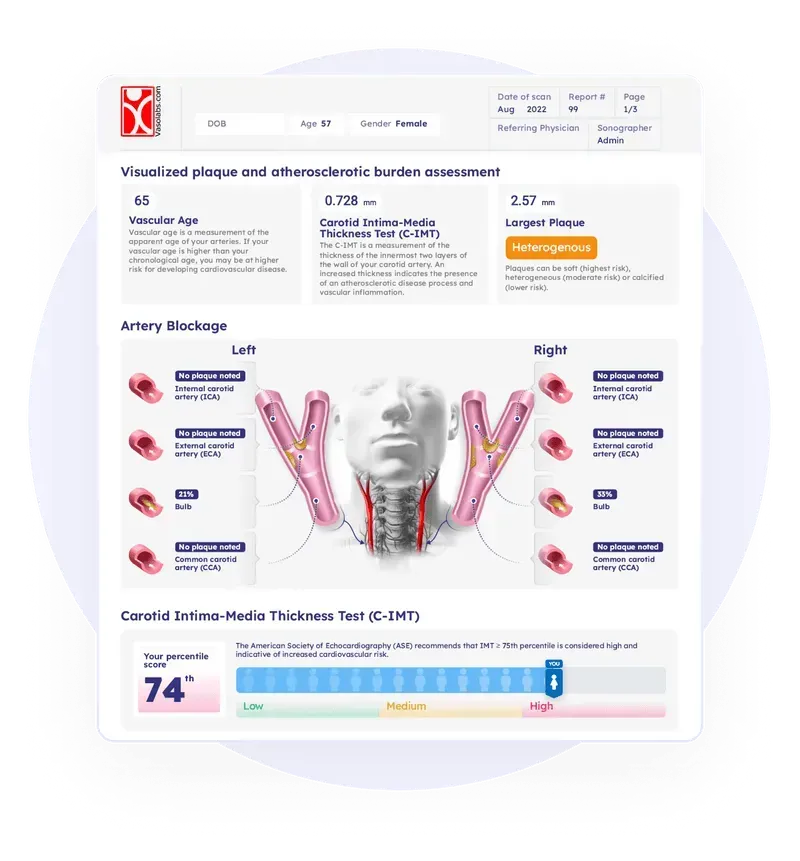
See your Vascular Age!
Soft or Calcified Plaque is visualized, you’ll see it all.
Track Your inflammation, Know your Artery Blockage.
Informed patients make better decisions.
Loved ones depend on you.
Do I Need a Heart Screening?
Here is a checklist of factors that put you at elevated risk for heart attack, stroke, and other forms of cardiovascular disease:
Over 40 years of age
Family history of heart disease/stroke
Overweight
Increased cholesterol level
High-fat diet
Tobacco user
High blood pressure
Diabetic
Metabolic syndrome
Erectile dysfunction
Psoriasis
Peace of Mind is Priceless

Looking back, it's chilling to realize how close I came to the edge. I opted for a test at Vasolabs on a whim, without any particular symptoms. Boy, am I glad I did! Turns out, my arteries were nearly clogged up - something regular doctors wouldn't have caught unless there were signs of a problem. By the time I got a couple of second opinions and returned to my regular doctor, my arteries were 95% blocked. If I hadn't taken the test when I did, I could have had a stroke. Trust me when I say this, going to Vasolabs was one of the best decisions I've ever made.
- George B
I was really worried about getting a heart attack because its already happened in our family. So taking this test gave me the peace of mind I was looking for. And it was so cool to see the age of my artery was younger than I was!!
- Barbara L.
I went to Vasolabs for their C-IMT testing, thinking it'd be a complicated deal, but nope! It was as easy as getting a photo taken. And guess what? They found an issue that could've been a silent threat. Thanks to them catching it early, my doctor and I are on top of it now. Honestly, I feel like I dodged a bullet. Big thumbs up for Vasolabs!
- Walter S.
I saw an ad on Facebook and I got the C-IMT Test for myself and my husband, it was such an easy process. And a great gift idea for family. It was really fun to look at the results and good to know I need to work on my health.
- Jessica F.
Frequently Asked Question
What is a C-IMT scan?
A C-IMT Scan is a non-invasive procedure that uses ultrasound technology to measure the thickness of your carotid arteries' walls. These arteries, located on each side of your neck, supply blood to your brain. Over time, plaque can build up in these arteries, causing them to thicken. This is often an early sign of atherosclerosis, a disease that can lead to serious conditions such as heart attacks and strokes.
Where do I go to get this scan?
For your quick, 15-minute appointment, simply head over to our facility located at 1414 South 600 West, Bountiful, UT 84010.
Who takes my test?
Dean Ence, an expert sonographer, will be handling your fast, no-pain test to figure out the 'age' of your arteries. This test checks how thick your artery walls are - thicker walls can mean inflammation. It's all simplified for you to understand easily. We also spot and show plaque, whether soft or hard, in your arteries. You get detailed pictures from the ultrasound for your records. Taking care of your health is our main goal!
How long does the C-IMT Scan and Report take?
The duration of the C-IMT scan can vary depending on various factors, like the complexity of the patient's condition. Typically, a Vasometric scan takes around 15 minutes to complete. The report is done and delivered within 24 hours to you.
Will my insurance cover this C-IMT Scan?
No. Hospitals charge $800, but our cost is $249.

Our Mission:
Vasolabs is dedicated to promoting heart health by providing innovative, easy-to-access tests. We empower people with insights into their vascular health for early risk detection.
Our Vision:
To redefine cardiovascular care by shifting the focus from late-stage disease management to proactive prevention.


